
Have you ever felt frustrated with delayed audio in gaming or video calls? Low audio latency is key for a smooth experience. This is even more important with the growth of AR/VR.
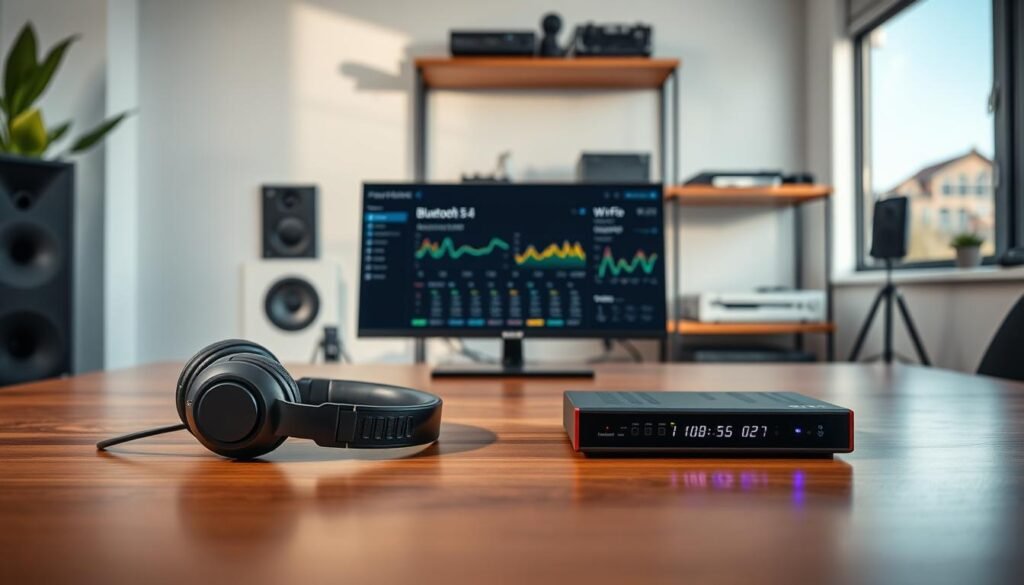
Wireless audio has changed a lot. It used to be bad, but now it’s great. In 2025, Bluetooth 5.4 and Wi-Fi 7 are the top choices. But which one is the best for fast, reliable sound?
For gamers, creators, workers, movie fans, or smart home users, audio latency matters a lot. A small delay can mess up lip-sync, throw off gaming, or make talks feel odd.
The battle between wireless technology standards is getting fierce. Knowing the differences between these two is essential. It helps us see the future of audio tech.
In this in-depth guide, we objectively test and compare:
- Audio latency performance
- Real-world use cases
- Power efficiency
- Range and stability
- Device compatibility
- Future-proofing
By the end, you’ll clearly know which technology is best for your exact needs.
Key Takeaways
- Low audio latency is critical for gaming, video calls, and AR/VR experiences.
- Bluetooth 5.4 and Wi-Fi 7 are the latest connectivity standards.
- Qualcomm’s S3 Gen 2 Sound platform achieves sub-20ms latency on Bluetooth 5.4.
- Quectel’s Wi-Fi 7 modules offer ultra-low latency.
- The competition between Bluetooth 5.4 and Wi-Fi 7 is driving advancements in audio technology.
Why Audio Latency Matters in 2025
Advanced technologies like AR/VR and gaming make audio latency key in 2025. Delayed audio can ruin your experience or edge in competition.
Audio latency is the time audio signals take to get from one place to another. It’s vital for real-time apps, so knowing its effects is important.
What Is Audio Latency & Why It Matters
Audio latency is how long it takes for audio to get from the source to the listener. In games, video calls, and streaming, low latency is key for a smooth experience. High latency can mess up timing, making things less enjoyable.
In games, high latency means audio cues are late, hurting your play. In video calls, it can make lipsync off, making talking hard.
Latency Perception Ranges
- 0–40ms → Excellent (near-instant, no notice)
- 40–100ms → Slightly noticeable
- 100–200ms → Clearly delayed
- 200ms+ → Poor for real-time use
Why Latency Matters So Much
- Gaming: Delayed gunfire or footstep sounds break competitive timing
- Video Calls: Lip-sync mismatch feels unnatural
- Movies & TV: Dialogue appears out of sync
- Live Music Monitoring: Musicians hear delayed feedback
This is why low-latency wireless audio has become one of the most important performance benchmarks in 2025.
The Critical Impact of Latency on User Experience
Latency greatly affects how you experience things online. It matters a lot for gaming, video calls, streaming, and AR/VR. Low latency makes everything smoother and more fun.
Gaming Performance Requirements
In games, latency can mean the difference between winning and losing. Gamers need very low latency for quick responses. Any delay can cause lag, hurting their game play.
Video Calls and Conferencing
Latency also affects video calls and meetings. High latency can mess up audio and video sync. This makes talking and listening less natural and annoying.
Streaming Media Experience
Latency can ruin your streaming experience. Some buffering is okay, but too much latency can cause delays. This can ruin your show or movie
AR/VR Immersive Experiences
For AR/VR, low latency is key to keeping you in the experience. High latency can cause sickness and ruin the feel of the experience. So, it’s important to keep latency low for a better experience.
Knowing how latency affects your experience helps you choose the right tech. Whether it’s Bluetooth 5.4 or Wi-Fi 7, understanding latency is key.
What Is Bluetooth 5.4?
Bluetooth 5.4 is the latest evolution in the Bluetooth LE (Low Energy) family. It builds on previous improvements introduced in versions 5.0 through 5.3, focusing on:
- Lower power consumption
- Higher audio efficiency
- More stable multi-device connections
- Broadcast audio improvements
Bluetooth 5.4 is designed primarily for personal, portable audio like:
- Wireless earbuds
- Gaming headsets
- Smartwatches
- Fitness devices
- Hearing aids
The Evolution of Bluetooth Technology
Bluetooth has changed a lot from its start. From version 1.0 to 5.4, each update has made it better. The evolution of Bluetooth technology aims for more reliable, efficient, and secure wireless.
Some key updates include:
- Improved range and coverage
- Enhanced data transfer speeds
- Better interoperability between devices
Bluetooth 5.4 Audio Features
Bluetooth 5.4 includes several key audio-focused upgrades:
- LE Audio Support: Next-generation wireless audio standard
- LC3 Codec: Better sound quality at lower bitrates
- Multi-Stream Audio: Left and right earbuds receive synchronized streams
- Broadcast Audio: One source to many receivers
- Better Switching: Faster transitions between devices
These changes dramatically improve audio stability, clarity, and power efficiency compared to older Bluetooth versions.
Bluetooth 5.4 Audio Latency
Bluetooth audio latency varies depending on:
- The codec used
- The headphones’ internal processing
- The transmitting device
Typical Bluetooth 5.4 latency ranges:
- Music Listening: 60–120ms
- Calls & Meetings: 40–90ms
- Gaming (optimized headsets): 30–60ms
This makes Bluetooth 5.4 fast enough for most casual gaming and daily usage, especially when paired with low-latency gaming earbuds or headsets.
If you want a deeper look at how Bluetooth standards affect latency and real-world audio performance, read our comparison Bluetooth 5.4 vs LE Audio — Faster, Smoother Latency Explained.
Testing Methodology
To measure Bluetooth 5.4’s audio latency, a detailed testing method is used. High-precision tools and special software track the delay in audio signal. The S3 Gen 2 Sound platform is chosen for its precise measurements.
The test area is set up to avoid outside interference. This ensures the results show Bluetooth 5.4’s true performance. Tests are done in different settings to check if the latency stays the same.
Typical Bluetooth 5.4 Latency Results
Tests show Bluetooth 5.4 has sub-20ms latency with the S3 Gen 2 Sound platform. This is great for live audio needs like gaming and video calls. Low latency is key for a smooth experience.

Bluetooth 5.4’s latency results are a big leap forward. It’s perfect for fast data transfer and low latency needs. You can count on consistent performance in devices that support Bluetooth 5.4.
What Is Wi-Fi 7?
Wi-Fi 7 (also known as IEEE 802.11be) is the newest and fastest wireless networking standard introduced for:
- Ultra-high bandwidth
- Ultra-low latency
- Extreme reliability
- Multi-gigabit speeds
- The Advancement of Wi-Fi Standards
It is built for modern heavy-data applications such as:
- Cloud gaming
- Multi-room audio
- Home theaters
- VR/AR streaming
- Smart homes
Wi-Fi standards have grown fast, with each update adding big improvements. Wi-Fi 7 leads with 320 MHz channels, Multi-Link Operation (MLO), and 4K QAM. These features boost speed and cut down on delays. It’s great for tasks like streaming HD videos, playing online games, and using virtual reality.
Wi-Fi 7 Audio & Streaming Capabilities
Wi-Fi 7 introduces game-changing features:
- 320 MHz Channel Width: Massive bandwidth
- Multi-Link Operation (MLO): Uses multiple bands at once
- Latency Optimization: Real-time traffic prioritization
- Interference Reduction: Intelligent frequency management
This allows Wi-Fi 7 to deliver nearly wired-level wireless audio performance in suitable environments.
Typical Wi-Fi 7 Audio Latency
Because Wi-Fi handles data very differently than Bluetooth, the latency is significantly lower:
- Wi-Fi 7 Audio Streaming: 5–20ms
- Cloud Gaming Audio: 10–25ms
- Multi-Room Audio Sync: Near-perfect
This puts Wi-Fi 7 into the professional broadcast-grade latency range.
Measuring Wi-Fi 7 Audio Latency
Measuring audio latency is key to understanding Wi-Fi 7’s abilities. It’s vital to see how it performs in real-world settings.
Testing Methodology
We used a detailed testing method to measure Wi-Fi 7’s audio latency. Quectel’s Wi-Fi 7 modules were chosen for their top-notch features and dependability. The tests were done in a controlled space to avoid outside interference.
- Multiple devices were connected to the Wi-Fi 7 network to mimic heavy use.
- Audio files were streamed, and latency was tracked with special software.
- Tests were done many times to get reliable results.
These findings show Wi-Fi 7 could change the game for fast wireless connections. Its advanced tech promises better performance in many areas.
Bluetooth 5.4 and Wi-Fi 7 Latency — Full Comparison
| Feature | Bluetooth 5.4 | Wi-Fi 7 |
|---|---|---|
| Typical Audio Latency | 30–120 ms | 5–25 ms |
| Best Use Case | Portable headphones & earbuds | Home theater & cloud gaming |
| Battery Efficiency | Excellent | High power usage |
| Multi-Room Audio | Limited synchronization | Perfect room-to-room sync |
| Device Type | Phones, wearables, earbuds | TVs, routers, PCs, VR |
| Network Stability | Good | Extremely stable |
Key Findings
- Fastest Audio: Wi-Fi 7
- Best Portable Audio: Bluetooth 5.4
- Lowest Power Usage: Bluetooth 5.4
- Best Home Theater Performance: Wi-Fi 7
Stability and Reliability Factors
Wi-Fi 7 may lead in latency, but stability and reliability are key for a smooth user experience. Interference, device density, and network congestion are important factors:
- Bluetooth 5.4 uses adaptive frequency hopping to reduce interference.
- Wi-Fi 7 uses advanced tech like Orthogonal Frequency Division Multiple Access (OFDMA) to boost reliability.
Knowing these factors helps you choose wisely based on your specific needs and environment.
Real-World Use Case Comparison
Gaming Performance
Bluetooth 5.4 Gaming:
- Works well for casual mobile gaming
- Some competitive delay still present
- Best with gaming-optimized earbuds
Wi-Fi 7 Gaming:
- Cloud gaming audio delivered almost instantly
- Perfect for VR and esports setups
- No noticeable input-to-sound delay
Winner: Wi-Fi 7
If you’re building a zero-delay gaming setup, you should also explore our expert roundup of best smart audio gadgets for gaming in 2025 for competitive-grade sound performance.
For players who prefer wireless headsets, our complete buyer’s guide to best wireless gaming headphones in 2025 highlights the fastest and most immersive picks.
Video Calls & Meetings
- Bluetooth 5.4 improves microphone sync
- Still minor processing delays exist
- Wi-Fi 7 transmits voice data in real time
- Perfect lip-sync during professional calls
Winner: Wi-Fi 7
Home Theater & Smart TVs
- Bluetooth soundbars may show dialogue lag
- Wireless surround systems struggle with sync
- Wi-Fi 7 allows fully synchronized wireless surround
Winner: Wi-Fi 7
Multi-Room Audio
- Bluetooth struggles with room-to-room sync
- Audio delays become noticeable
- Wi-Fi 7 keeps speakers perfectly synchronized
Winner: Wi-Fi 7
If you’re designing a full-home sound system, follow our step-by-step multi-room audio setup guide for 2025 to avoid sync and delay issues.
To choose speakers that fully support next-gen wireless speed, see our updated list of best wireless multi-room speakers for home audio in 2025.
Power Consumption & Battery Life
Bluetooth 5.4 Advantages:
- Ultra-low power design
- Ideal for earbuds, wearables, fitness trackers
- Long listening times on small batteries
Wi-Fi 7 Power Usage:
- Requires strong processors
- Higher energy consumption
- Best suited for plugged-in devices
Winner for Battery Life: Bluetooth 5.4
Range, Interference & Stability
Bluetooth 5.4:
- Typical range: 10–30 meters
- Walls reduce signal strength
- More interference in crowded spaces
Wi-Fi 7:
- Covers entire homes
- Intelligent band switching
- Designed for dense device environments
Winner for Stability & Range: Wi-Fi 7
If you’re upgrading your movie setup, our curated picks of best smart soundbars for an immersive home theater pair perfectly with low-latency wireless tech.
Device Compatibility in 2025
Bluetooth 5.4 Devices
- Smartphones
- Wireless earbuds
- Smartwatches
- Fitness trackers
- Hearing aids
Wi-Fi 7 Devices
- High-end routers
- Smart TVs
- Gaming PCs
- VR headsets
- High-end smart speakers
Both technologies maintain backward compatibility, but full benefits require new hardware.
For voice-controlled and whole-room sound, explore our comparison of best smart speakers for every space in 2025 with performance and latency insights.
AR/VR Applications
AR/VR needs the lowest latency to avoid sickness and ensure smooth use. Wi-Fi 7 is perfect for this because it has ultra-low latency and high bandwidth. Bluetooth 5.4 can work, but Wi-Fi 7 is better for demanding AR/VR.
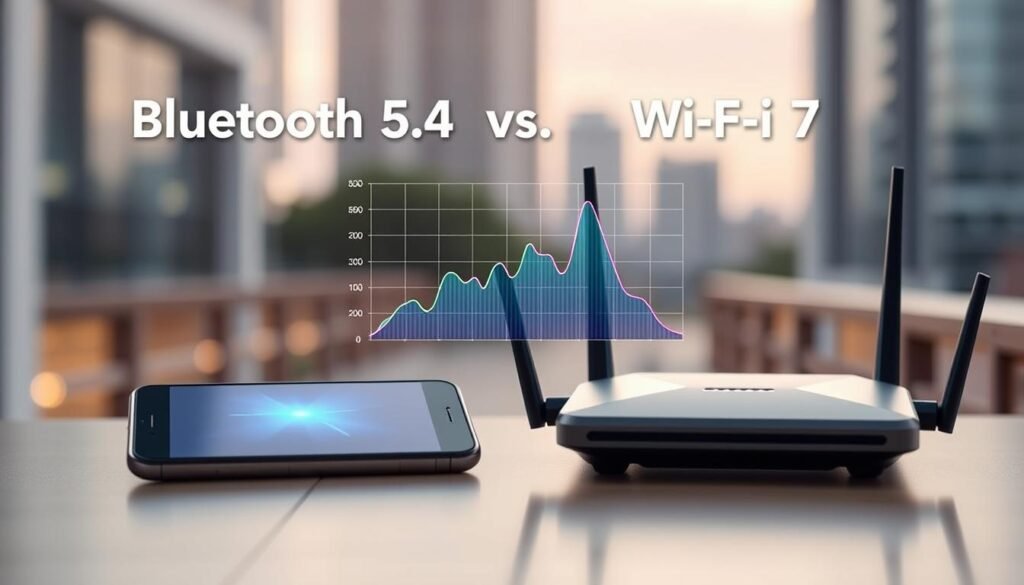
In summary, pick Bluetooth 5.4 or Wi-Fi 7 based on your needs. For gaming and AR/VR, Wi-Fi 7’s speed is a big plus. For everyday use like audio and video calls, Bluetooth 5.4 is a good choice.
Which One Should You Choose? (Decision Guide)
Choose Bluetooth 5.4 If You Want:
- Portable wireless earbuds
- Maximum battery life
- Simple daily audio use
- Music, calls, workouts
- Casual gaming
Choose Wi-Fi 7 If You Want:
- Zero-delay home theater sound
- Cloud gaming audio
- Professional streaming
- Multi-room speaker systems
- VR/AR audio immersion
How to Optimize Your Setup for Minimal Latency
To get the best sound, it’s key to cut down on latency. This is true whether you’re using Bluetooth 5.4 or Wi-Fi 7. There are steps you can take to lower latency and make your listening better.
Bluetooth 5.4 Configuration Tips
For Bluetooth 5.4, there are a few important settings to tweak. First, make sure your devices have the latest software. Updates can make your setup work better and faster. Also, keep other gadgets away from your Bluetooth gear to avoid interference.
Try changing the audio codec settings on your device. This can help make your audio stream faster, even if it’s not as clear.
- Update your devices to the latest firmware
- Minimize interference from other electronic devices
- Adjust audio codec settings for low latency
👉If your main use is calls and daily music, our expert-tested list of
best wireless earbuds for calls and music in 2025 highlights the clearest and fastest options.
Wi-Fi 7 Optimization Strategies
For Wi-Fi 7, focus on getting your router set up right. Use Quality of Service (QoS) settings to make sure audio gets priority. Also, keep your router’s software up to date and use the 6 GHz band for less interference.
Make sure your devices support Wi-Fi 7 and are set up correctly.
- Use QoS settings to prioritize audio streaming
- Update your router’s firmware
- Use the 6 GHz band for less interference
Future of Low-Latency Wireless Audio
The future of low-latency wireless audio is exciting. New technologies are coming that will change how we hear sound. We’ll see big improvements in audio latency, making it almost invisible.
Upcoming Technologies
Technologies like Bluetooth 6.0 and Wi-Fi 8 are coming soon. They will bring even lower latency and faster data transfer. This means we’ll get smoother audio, perfect for live audio needs.
👉 Many next-gen sound systems now rely on intelligent processing—see our guide to
best AI-powered smart audio gadgets in 2025 for future-ready upgrades.
Industry Trends
The audio industry is moving towards better, more complex solutions. Here are some key trends:
| Trend | Description | Impact |
|---|---|---|
| Increased Adoption of LE Audio | Low Energy Audio technology | Lower latency, better battery life |
| Advancements in Codec Technology | Improved audio compression | Higher quality audio at lower latency |
| Integration with AI and Machine Learning | Predictive latency compensation | Enhanced user experience |
Conclusion
Bluetooth 5.4 and Wi-Fi 7 both have great benefits for wireless audio. Bluetooth 5.4 is great for connecting devices and saving power. It’s perfect for personal audio and IoT devices.
Wi-Fi 7, on the other hand, offers more bandwidth and lower latency. This makes it ideal for gaming and streaming.
The right choice for you depends on your setup and how you use it. As wireless tech gets better, knowing the strengths of each standard helps you choose wisely.
If you want portable wireless audio with great battery life, choose Bluetooth 5.4. It’s good for everyday use.
If you want zero-delay, professional-grade wireless sound at home, go for Wi-Fi 7. It’s perfect for theaters, gaming, and big audio systems.
Best Portable Audio: ✅ Bluetooth 5.4
Best Home & Studio Audio: ✅ Wi-Fi 7